Sunday, 11 December 2011

Planet Earth - The Archaean Eon (edited and added)

Okay, so I seemed to have fallen at the first hurdle of getting a post out per day, but I had a great evening talking with two inhabitants of Whatlington, one from Battle and one from Cranbrook. The results of this will go on the blog soon, but we still have 3,800 million years to go. 

So may I introduce to you, the Archaean Eon or Era - It is dated, through chronometry, from 3,800 million years to 2,500 million years ago. It is said that the surface of the planet had solidified and with the accretion of extra-terrestrial material on to the planet; the day's length had increased from 7 hours (Hadean Eon) to fifteen hours. The heat flow of the planet was three times greater than the present level. This is due to three factors; the aforementioned accretion, heat from the proto core and the heat from the decay of radioactive elements. The tectonic and volcanic activity was thought to be high, although evidence of tectonic plate movement is still being examined by scientists to see if it occurred at that time.

The palaeo-atmosphere of the Archaean environment is thought to have 75% nitrogen and 15% carbon dioxide; the luminosity of the sun was estimated to between 70-80% of the present sun.

Water, in a liquid form, is thought to have been present as it has been recorded in deformed gneisses (a form of metamorphic rock).

By the end of the Archaean Eon, evidence of geological  features included continent-continent collisions, intracontinental rifts, sedimentary basins, volcanic arcs and the forms left by the creation and destruction of proto and supercontinents. Rocks with Archaean history can be found at the Baltic Shield Canadaian Shield, Greenland, India, Scotland, Southern Africa and Western Australia. These rocks are often named as banded iron formations, greywackes, mudstones and volcanic sediments, there were few carbonate rocks due to the acidic levels in the oceans (more can be found at Archaean Palaeo-Geology).

A recent article in the New Scientist, 25th of November 2011, suggests that there is evidence that supports the theory of the Last Universal Common Ancestor (LUCA). It reports that a mega-organism that lived in the Archaean oceans gave rise to the three domains of what we now know as life - the single celled, the archaea and the eukaryotes. This mega-organism or LUCA was not the first example of life, but it was the first successful one that can be supported by present day evidence of inherited proteins from LUCA.

"Caetano-Anollés searched a database of proteins from 420 modern organisms, looking for structures that were common to all. Of the structures he found, just 5 to 11 per cent were universal, meaning they were conserved enough to have originated in LUCA" (New Scientist 2011). LUCA also gave rise to cell membranes, organelles (cell compartments with specific functions); it had a varied metabolism and it may have used ribonucleic acid (RNA), which stores information and controls the chemical reactions. As Caetano-Anollés states, "LUCA was a clumsy guy trying to solve the complexities of living on primitive Earth" (New Scientist 2011).
Despite there being no known fossils of eukaryotic life from the Archaean Eon, we have seen, above, that inherited proteins show a last universal common ancestor; but we do have fossils of mats of a form of bacteria, Cyanobacteria or blue-green algae, which is thought to have created free oxygen in the atmosphere. These mats are also known as stromatolites - a structure formed in shallow water that bind cement and trap grains of sediment within a biofilm of the micro-organism, such as the Cyanobacterium. Stromatolite fossils are easily found within the Pre-Cambrian period (dates from 4,600 million years ago to 542 million years ago - a period of time that represents 88% of geological time).
Today Stromatolites can be found in the Bahamas, Brazil, Canada, Mexico, Turkey and Western Australia near salt and fresh water, although there is one example that lives in the Jenolan caves in Australia and survives from calcium rich water that percolates through limestone.
Next time - The Proterozoic Eon 

Wednesday, 7 December 2011

Planet Earth - The Hadean Eon - Part Two

It started from approximately 4.5 billion years ago and ended approximately 3.8 billion years ago; the Hadean Eon named by the geologist, Preston Cloud , in 1972 was used to represent a time of bombardment by extra-terrestrial material, fire and possibly like a vision of hell. 

The examination of the moon's surface and by dating moon rock, it has helped to partition the Hadean Eon into further time periods:

Birth of the Moon - (4.527 billion years ago) an approximate date for when a bombardment hit the molten proto-planet Earth and thus created a satellite.

Pre-Nectarian - (3.92 billion years ago) an approximate date of the crust's formation of the moon.

Nectarian - (3.85 billion years ago) an approximate date of when the terrestrial bombardment started to recede.

Using locations in western Greenland, north western Canada and Western Australia, there are provisions of  evidence of Hadean sediments (Greenland) and zircon crystals (Australia and Canada). The crystals are estimated at 4 billion years old and the sediments to 3.8 billion years old. The latter rock has also evidence of banded iron beds with the potential for organic carbon and with that it suggests that photosynthetic life had already been established.

But as with all science and their associated theories and evidence; the suggested period of Hadean-like life as purported by Preston Cloud may be be different. During the time of bombardment, approximately 4.527 billion years ago, an impact into the partially molten planet may have formed the Earth's satellite, the moon. This dislodgement not only moves material but it also dislodges water molecules that have been trapped within the planet's rock structure and surface into the proto-atmosphere. This is due to the gravity of the planet being less strong due to the planet being 40% of its present size. This proto-atmosphere consisted of a heavy carbon-dioxide atmosphere laden with hydrogen and water vapour (a combination of hydrogen and oxygen). The raised atmospheric pressure, due to the presence of carbon dioxide led to collections of water be present on the planet's surface despite a suggested surface temperature of two hundred and thirty degree Centigrade (446 degrees Fahrenheit in old money).

The study of the zircon crystals in 2008 has shown that liquid water may have been present 4.4 billion years ago and they may also hold evidence of plate tectonic activity approximately 4.0 billion years ago. The action of subducting (sinking) plates traps both rock and carbon dioxide, so as the process carried on  it took more carbon dioxide out of the atmosphere. This reduced the greenhouse effect leading to a cooler surface temperature, the formation of rocks and even life. This, of course, at present is partially conjecture based on archaeo-geological (or palaeo-geological) evidence and next time, we enter the Archaean Eon. 

Tuesday, 6 December 2011

Planet Earth - The Hadean Eon - Part One

Hope you are still with me - please bear with me whilst I distill the vital ingredients for the history of the Hadean Eon of Earth's History. However can I suggest you listen to the recent episode of The Infinite Monkey Cage that explains the origins of life - I will be using the information from this show as well as other resources - this happens to be a happy example of synchronicity. Synchronicity happens to pop up a lot in the history of both Whatlington and Vinehall Street from the dawn of time until 2012.

Monday, 5 December 2011

Planet Earth - the early years, I mean the really early years

Hello there and welcome - the last five posts have taken you, the reader, as well as me; the writer who has sneakily used other people's work to take you from that point of 10–43 seconds after the Big Bang Event (BBE) to an estimated time of 9.2 billion after the BBE. Yes, of course I have taken necessary steps to simplify parts and if you would like to add some descriptions in the comment section below this post.

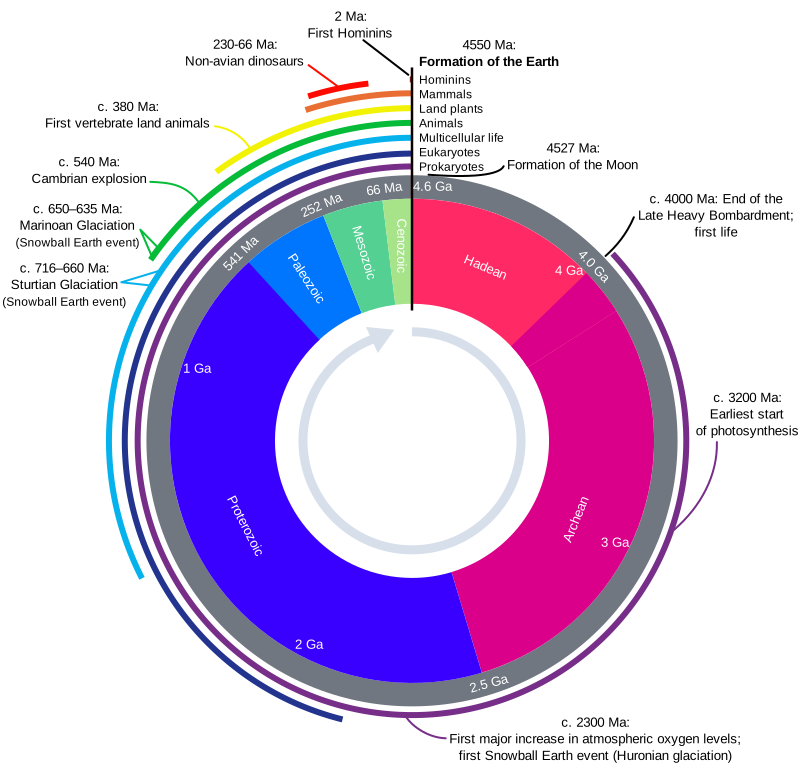
So, of course, our next question or at least the path of where we gain our next part of the history of Whatlington and Vinehall Street is how did planet Earth form from the stellar material (or supernovae) that is ejected from collapsing old stars. It should also be stated, at this point, that the current estimated age of Earth is 4.578 billion years and those kind compilers at Wikipedia, as you can guess, have designed a geological clock (see below) on which I base the next section of the Whatlington and Vinehall Street Archive. We are often reminded that three is the magic number, the age of Earth is approximately one third of the age of the Universe.

(Click on the image to see a better view)


It is purported that certain planets in our solar system were formed from the solar nebula, the disc shaped cloud of dust and gas, whereby dust grains start to orbit around what may be described as a protostar - a contracting mass of gas that represents the beginning of a star - his process is known as accretion. The accretion of the dust grains leads to clumps reaching sizes of up to 200 metres, these larger clumps bind together to form planetesimals - a minute planet of up to 10 kilometres in size. With increasing accretion due to gravitational force, these planetesimals increased in size by centimetres over the millions of years. 

Due to the position of Earth, and the other terrestrial planets, in relation to the Sun - volatile molecules were unable to condense such as methane and water. However the planetesimals could only form elements with high melting points including such metals as iron (Fe), nickel (Ni) and aluminium (Al) and rocky compounds such as silicates (SiO4). But due to the low presence of these metals and compounds in the solar nebula, they form 0.6% of the solar nebula, the so-called terrestrial planets (Mercury, Venus, Earth and Mars) were limited to being of a smaller size compared to the gas giants (Jupiter, Saturn, Uranus and Neptune). The liquid metals started to sink towards the mass's centre of the proto planet that would be known as Earth. This led to an event entitled the Iron Catastrophe, a supposed date of this event is 500 million years into the formation of Earth, where the collection of iron and nickel at the central mass led to the separation of the mantle and core. This led to the layered structure of Earth and its magnetic field. 

Before I leave you today, a cloud of gaseous silica was said to have surrounded the planet like an early form of atmosphere, this cloud would condense and form the rocks on the Earth's surface. This led to another form of atmosphere that was created when the proto Earth had increased its size to approximately 40% of today's size by accretion - thus the force of gravitational attraction retained a proto atmosphere that also stored water.

Have a good day and thus we travel further on to the Hadean and Archaean Eons next time.

Sunday, 4 December 2011

A romp through spatial time

From that time of 1 second after the Big Bang Event (BBE) to 400,000 years after the BBE, the temperature of the expanding quark-gluon fog  had decreased from 10 billion degrees Centigrade to a more amenable 2,700 degrees Centigrade. This decrease in the temperature allows the electrons, sub atomic particles with a negative elementary electrical charge, to combine the previously mentioned protons and neutrons to create atoms. It is suggested that the first few elements that are created by the collection of atoms are Helium (with one atom) and Hydrogen (with two atoms). It is also suggested that light starts to begin the process of illumination.
For the next billion years, the first natural force that was separated after the BBE, gravity starts to make both Helium and Hydrogen to join together, or coalesce, to form giant clouds and this is aided by the drop in temperature from the previously recorded positive 2,700 degrees Centigrade to negative 200 degrees Centigrade. These giant clouds start to form galaxies and I don't mean the chocolate or the mobile devices! The smaller clumps of Helium and Hydrogen of gas collapse to create the first examples of stars, a massive sphere of illuminated and ionised charged particles or plasma, within the universe.

After that initial billion years, it is purported that the temperature drops further to negative 270 degrees Centigrade for the the next 13.7 billion years. This allows the previously mentioned galaxies, a massive mixed system of dust, gas and stars (as well as the remains of previously formed stars) that are conjoined by gravity as well as the recently discovered but not very well understood dark matter. It is called dark matter due to the fact that it neither emits or scatters light nor does it emit or scatter electromagnetic radiation. It is stated that 95% of all matter in the universe is either dark energy or dark matter. During this 13.7 billion years, as old stars collapse and they eject heavy elements into space and this material is recycled into new planets, this being a body that travels around either a star or the remains of a star and is neither big enough to create thermonuclear fusion, and stars.  

The universe has been aged at 13.7 billion years, a year being defined at 365.25 days or 86,400 seconds, however for the sake of this blog, I am ending this section of the blog at 9.2 billion years as I am leaving 4.5 billion years for the formation of the planet we know as Earth. 
I hope you are enjoying this romp through time, please add a comment if I have got things wrong or just say that you are enjoying it.

Friday, 2 December 2011

Supersymmetry Breaking, the Quark Epoch and the Hadron Epoch

Another day and slightly closer to finding why Whatlington and Vinehall Street are where they are today and how their past has formed the present.

Supersymmetry Breaking

The is first period was when the last two forces, electromagnetism and the weak nuclear force were separated and the subThe universe starts to cool from its original heat of 1,000 trillion, trillion degrees Centigrade to only 10 trillion degrees Centigrade; this cooling allows those quarks - remember those particles we met last time - to combine and form protons and neutrons. A proton is known as a subatomic positively charged particle of one elementary charge, the number of protons in an atom is shown in its atomic number on those old posters of the Periodic Table.


Back to the science, a neutron is the subatomic hadron particle that has no electrical charge with a mass slightly larger than a proton. 

The Quark Epoch (between 10–12 seconds and 10–6 seconds after BBE) had too high a temperature to allow the quarks to form a hadron. The hadron is a composite particle made up of quarks held together by, what is known in the particle physics community as, a strong force.

During the Hadron Epoch (Between 10–6 seconds and 1 second after BBE) the temperature of the plasma-gluon cloud, remember that one, cooled to 10 billion degrees Centigrade and this allowed the quarks to cool and form hadrons. Neutrons slowly become protons and our first element, Helium, starts to form a nuclei. But the temperature is still too hot for atoms to form.

Next time - we fast forward our trip to the formation of the third rock from the sun.

Thursday, 1 December 2011

The Electroweak Epoch and The Inflationary Epoch

I hope that I haven't lost you so far with a very concise history of the expanding universe so far, we have only covered up to 10–36 seconds after the Big Bang Event (BBE). But within this expansion will be two villages, namely Whatlington and Vinehall Street.

There are two schools of Big Bang Cosmology, the traditional and the inflationary. The traditional school states that the electroweak epoch began at 10–36 seconds when the temperature is low enough to separate the strong force from the electroweak. The inflationary school suggests that the electroweak epoch began when the inflationary ended at 10–32 seconds after the BBE. Cox and Cohen (1996) appear to subscribe to the inflationary school and put the inflationary epoch before the electroweak epoch.

The Inflationary Epoch describes a time of super fast expansion of the universe from the size of an atom (between 30 & 300 picometres or 1.0 x 10⁻¹² metres) to that of a grapefruit (between 5 & 8 centimetres or 0.01 metres) in the period of 10-21 seconds; thus the expansion increased both lineal and volumetric dimensions. A theorised version of the BBE when it was the size of a grapefruit was theoretically donated to the Museum of Curiosity, a BBC Radio 4 programme, by John Gribben. It is said that if the speed of expansion decreases the universe becomes more chaotic and conversely if the expansion gains accleration it creates a more ordered universe.

Within this expansion is a collection of anti-quarks (the opposite of a quark), electrons (stable subatomic particle with a charge of negative electricity), gluons (a massless, neutral vector boson that mediates strong interactions between quarks, binding them together within hadrons), quarks (an elementary and fundamental particle of matter) and other particles. It is also known as a quark-gluon plasma. The temperature within this expanding space is still around 1,000 trillion, trillion degrees centigrade. This quark-gluon plasma will help to repopulate the universe as it enters the electroweak epoch. I am sure when I was young, there was a type of yoghurt or cheese called Quark.

The Electroweak Epoch was a time (from 10–36 seconds or the end of the inflation epoch to 10–12 seconds after the BBE) within the universe's evolution that the 1,000 trillion, trillion degree centigrade heat was able to combine both the electromagnetic force with the weak interactions to form one electroweak interaction. The energetic interactions of the previously named particles within the dense and hot quark-gluon plasma created large quantities of exotic particles - these included the W, Z and Higgs boson. The Large Hadron Collider (LHC) at CERN is attempting to recreate the Higgs boson and other particles. The quarks start to gain mass like the stomach of a person during the meal on Christmas Day.

In brief, a really small cloud of particles expanded to a slightly bigger cloud with these particles becoming slightly heavier and less chaotic. We haven't even reached a second after the BBE yet.

Next time - Supersymmetry Breaking, the Quark Epoch and the Hadron Epoch.


Next time, The Quark Epoch and The Early Universe, have a good day.